Maybe you lift weights and a friend keeps telling you to try Reformer, or maybe you've always pictured Pilates as gentle stretching on a mat. Either way, you want to know whether fifty minutes on that sliding bed is actually going to make you stronger, and it will. Reformer Pilates builds muscle because the springs on the machine are real resistance, and you're working against them for most of the class. It's at its best for strength and staying power, and there are a couple of things it won't do, which I'd rather tell you now than have you find out a few months in.
What the springs are actually doing
A reformer is a padded carriage on wheels that runs along a wooden frame, held back by a set of springs. Every time you push the carriage away with your legs or draw it in with the straps, you're working against those springs. Then, as it comes back, you're holding it steady so it doesn't clatter home, and that slow return is where a lot of the work happens. Your muscles are busy on the way out and on the way back, so there isn't much time in a class where you're simply resting.
The springs can be made heavier or lighter, and your instructor tells you how to set them for each exercise. New people are often caught out by this, because lighter doesn't always mean easier. With less spring holding the carriage, your tummy, your hips and the small muscles around your shoulders have to do more of the steadying themselves, so a light setting can leave you wobbling more than a heavy one. Our classes page calls it "that feel-good shake", and you'll know exactly what it means after your first class.
Which muscles get the work
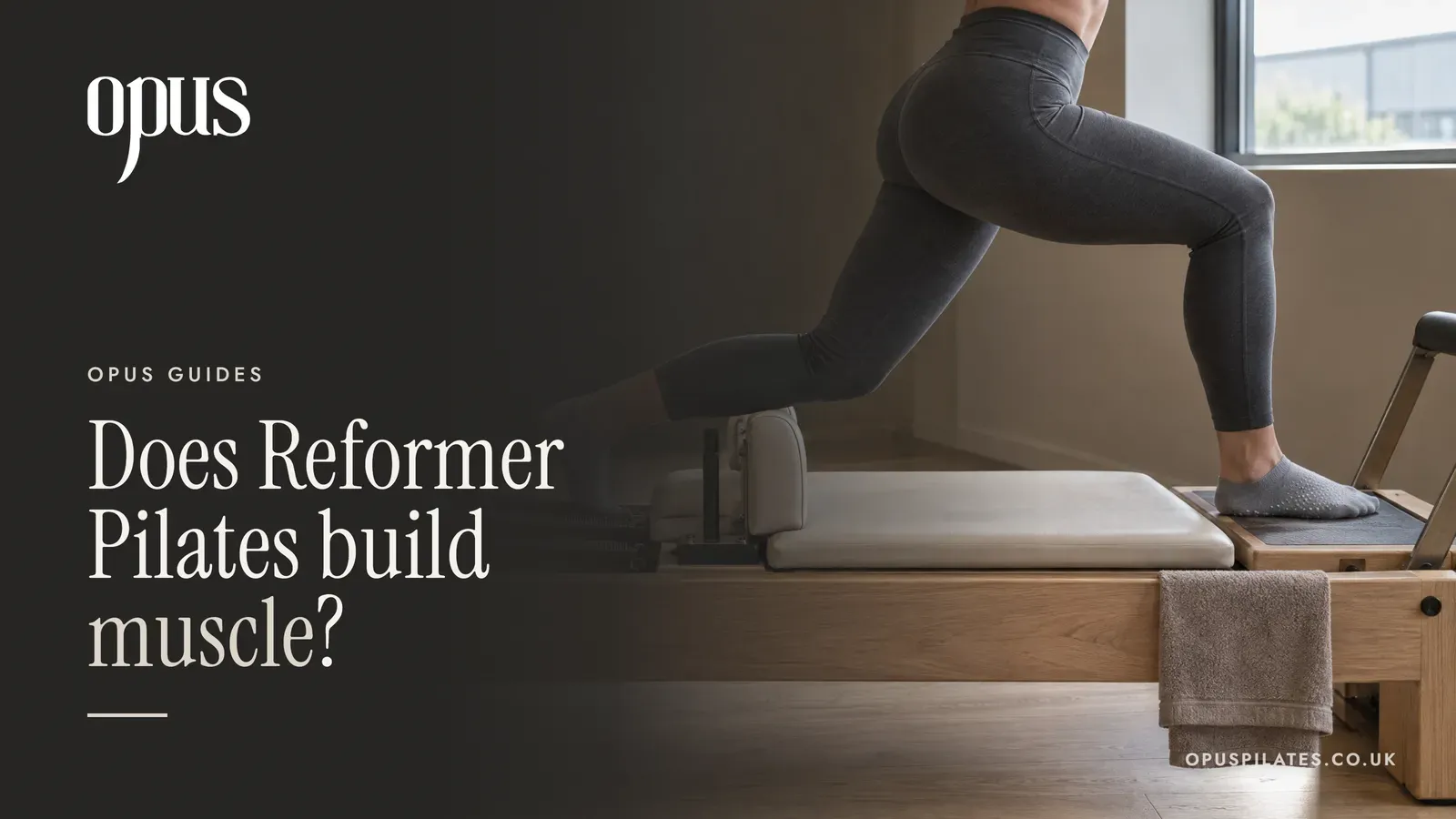
Over a whole class, pretty much all of them. Reformer exercises where you press the carriage out with your feet go after your thighs, calves and bottom. Pulling the straps with your arms works your back, shoulders and the backs of your arms, and when you do that kneeling or sitting up, your middle has to keep you upright while your arms move. Work on your side or on your knees asks your hips and legs to keep the carriage exactly where you want it, which takes far more effort than it seems when you're watching someone else do it.
That's why we describe Reformer as a full-body workout for strength, tone, flexibility and posture. You won't spend fifty minutes on one body part the way you might on a gym leg day, and you don't need to plan which muscles you're doing this week either. You just turn up, and the class makes sure everything gets a turn.
How it compares with lifting weights
If you're used to dumbbells, the springs will feel a bit strange at first. A dumbbell weighs the same at the bottom of a curl as it does at the top, but a spring pulls harder the further you stretch it, so an exercise gets tougher as you reach the end of it, right where you're most tempted to let go. And because the spring is always trying to pull the carriage home, you can't just drop it at the end of a rep the way you'd put a weight down. You have to bring it back under control every single time.
The other big difference is how you make it harder. In the gym, you add a bit more weight and write the number down. On a reformer, your instructor makes things harder by changing the springs or bringing in a tougher version of the same exercise, and you can make almost anything harder yourself just by moving more slowly. It's less easy to track on paper, but you'll feel it, and moves that had you wobbling in your first few weeks start to feel steady.
Strength, yes. Getting bigger, probably not
If by building muscle you mean getting stronger and firmer, so you can hold a position for longer with more control, then Reformer is a very good way to do it. If you mean getting noticeably bigger, that's a different job. Putting on real size generally means lifting loads that keep going up month after month, and eating and resting to match, which is how bodybuilders train. A reformer's springs only go so heavy, and Pilates cares more about control than about piling on weight, so it isn't the tool for chasing size.
That should also settle the "I don't want to get big" worry, if it's what's been holding you back, because Reformer isn't going to do that to you by accident. And for anyone who already lifts with size as the goal, it can still earn a spot in your week as the session where you slow right down and work on control and moving well.
Getting more out of every class
Muscles respond to work done regularly, so the most useful thing you can do is keep coming back. Twice a week is a sensible aim if your diary allows it, and I've written about how often to do Reformer Pilates in more detail if you're weighing up a plan. A class every few weeks will feel lovely, but it won't change a great deal on its own.
In the class itself, slow down. It's tempting to rush the carriage back and forth to get through the reps, but the controlled part is doing a lot of the work, so take your time as it comes back in. If an exercise starts to feel easy, ask your instructor about the springs, and once you're comfortable with the basics, the Reformer Intermediate-Advanced classes on weekday evenings will give you more to push against. Away from the studio, the dull stuff counts as well: eating enough and sleeping properly are what let your body recover and get stronger between sessions.
When you want heavier strength work
For anyone whose main goal really is strength, INTENSE is worth a look. It's the class Tyler leads in our second room: strength training done slowly, with your muscles kept under tension from start to finish and your whole body getting worked, and as we put it on the site, "This is not Pilates, and it is not your local gym." Numbers are capped at six, and INTENSE is priced and sold separately from Reformer, with memberships of its own.
HYBRID is there for people who want some of each. HYBRID 8 is £129 a month for four Reformer classes and four INTENSE, so roughly one of each a week, while HYBRID 16 doubles both for £199. The split is fixed, classes don't roll over and there's a three month minimum. Karen N summed up one of Tyler's sessions like this: "Great class so hard at times. Loving this Intense, thank you Tyler." Everything else is on the INTENSE page.
Trying Reformer Pilates at Opus in Rotherham
Newcomers start in Reformer (All Levels), so that's the one to book if the machine is new to you. Reformer classes last 50 minutes (an hour on Saturdays) and they're capped at eight, so whoever's teaching can see what you're doing and help you with the springs. Paula, Louie and I teach Reformer between us. As a new member, your first two Reformer classes cost £30 together and you've got 30 days to use them, and our guide to your first Reformer class walks you through what happens when you arrive.
Grip socks are a must on every Reformer class, and the desk has pairs for sale if you don't own any. Give yourself an extra ten minutes on your first visit so we can show you round. We're at Unit 4, Bridge Court, where parking's free on site, and if you're coming over from Sheffield, our page for Sheffield visitors has more on getting here. You can read how our Reformer Pilates classes in Rotherham run, or give the studio a call on 01709 432103 for help choosing your first class.
Questions
Do I need to be strong already to start?
No. Your instructor can set the springs light enough for someone who's never done any strength work, and Reformer (All Levels) is there for people starting out, so nobody expects you to keep up with the person beside you from day one.
Can I do Reformer on the same day as the gym?
You can, it's your call. If your legs are tired from a heavy session, tell your instructor before class so you can take the leg work a little easier that day.
Is Mat Pilates as good as Reformer for building strength?
For strength, Reformer gives you more to push against, because the springs add resistance that can be made heavier. On the mat you're working with your own body weight and small props, with no machine assisting you or resisting you, and that's hard work in its own way. Charlotte teaches Mat on Sunday mornings, and there's nothing stopping you doing both.
Will I ache after my first class?
You might feel it in your legs or your middle the next day, especially if it's a new way of moving for you. That usually eases as your body gets used to the classes. If something actually hurts, as opposed to just feeling worked, stop and tell your instructor there and then, and if it doesn't settle, have a word with your GP.
New to Opus
2 Reformer classes for £30
Try Reformer at Opus, booked online in a minute. New members only.
Start for £30 See the timetableLast updated 20 November 2026